

Time Travel in Physics: Is It Possible, or Just a Paradox?
Dive into the science of time travel theories, from wormholes to time loops, and the paradoxes that challenge our understanding of the universe.
 Sly Puzzle Games
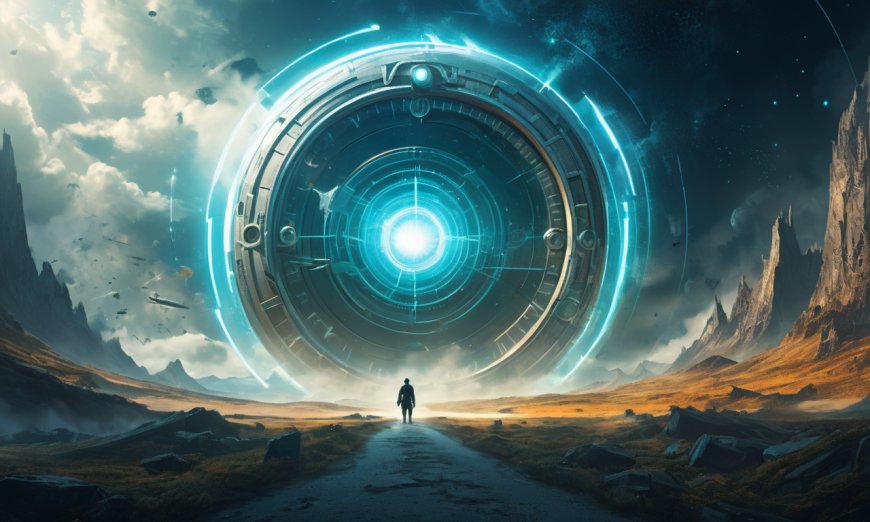


Time travel has long been a subject of fascination in science fiction, but is there any scientific basis for it in reality? The concept of time travel stretches our imagination, challenging our understanding of physics and the very nature of time itself. Could we actually travel to the past or future, or are the paradoxes associated with time travel too overwhelming? From the theoretical possibility of wormholes to the perplexing paradoxes of time loops, we’ll explore the science behind time travel and the questions it raises about the universe.
The Nature of Time: Linear or Flexible?
- Time in Classical Physics
In classical physics, time is viewed as a constant, flowing in a linear fashion from the past to the future. Isaac Newton described time as an absolute, ticking away at a constant rate, independent of the observer. In this framework, time travel seemed impossible—an immutable sequence of cause and effect governs the universe, and moving backward or forward in time beyond our current moment was unthinkable.
- Einstein’s Theory of Relativity: Bending Time
Albert Einstein’s theory of relativity revolutionized our understanding of time, suggesting that time is not fixed but can be influenced by factors such as gravity and speed. According to Einstein’s special theory of relativity, time slows down as objects approach the speed of light—a phenomenon known as time dilation. This means that for an astronaut traveling at near-light speeds, time would pass more slowly compared to someone on Earth, effectively allowing the astronaut to travel into the future.
In his general theory of relativity, Einstein further proposed that gravity can bend spacetime, the four-dimensional fabric that unites time and space. Massive objects, like stars and black holes, warp spacetime, creating the possibility of time travel by distorting the flow of time itself. This opened the door to the theoretical possibility of time travel, particularly through concepts like wormholes.
Wormholes: Pathways to the Past or Future?
- What Are Wormholes?
Wormholes, also known as Einstein-Rosen bridges, are hypothetical tunnels in spacetime that could potentially connect distant points in space and time. First proposed in 1935 by Einstein and physicist Nathan Rosen, wormholes are solutions to the equations of general relativity that suggest shortcuts through spacetime. If such structures exist, they could allow a traveler to move between two distant points almost instantaneously—or even travel to different times.
The idea is simple: imagine spacetime as a two-dimensional sheet of paper. If you fold the paper in half and poke a hole through it, you’ve created a shortcut between two points. In theory, traveling through a wormhole would allow a person to move between two points in space (and possibly time) much faster than traveling through normal space.
- Challenges of Wormhole Time Travel
While wormholes are mathematically possible, they come with significant challenges. First, there is no experimental evidence that wormholes actually exist. Second, even if they do, most theoretical models suggest they would be incredibly unstable. Any attempt to travel through a wormhole could cause it to collapse, destroying both the traveler and the wormhole itself.
Furthermore, the energy required to keep a wormhole open might be impossible to achieve. Some physicists have proposed that "exotic matter" with negative energy could stabilize wormholes, but such matter has yet to be discovered.
Time Loops and Paradoxes
- The Grandfather Paradox
One of the most famous time travel paradoxes is the Grandfather Paradox, which poses the following dilemma: if you traveled back in time and killed your grandfather before your parent was born, you would prevent your own existence. But if you never existed, how could you have gone back in time to commit the act in the first place?
This paradox highlights the logical inconsistencies that arise from time travel to the past. If actions in the past can affect the future, then time travel could lead to impossible situations, where causes and effects contradict each other.
- The Bootstrap Paradox
The bootstrap paradox involves an object or piece of information that exists without ever being created. For example, imagine a time traveler who goes back in time and gives William Shakespeare a copy of "Hamlet." Shakespeare then publishes the play, and centuries later, the time traveler reads it, memorizes it, and takes it back in time to give to Shakespeare. In this case, who originally wrote "Hamlet"? The information seems to exist in a closed loop, without a clear origin, violating the principles of causality.
- The Novikov Self-Consistency Principle
To resolve these paradoxes, some physicists propose the Novikov self-consistency principle, which suggests that time travel to the past is possible, but only if it does not create contradictions. In other words, events in the past are fixed and cannot be altered, even by a time traveler. If you attempted to kill your grandfather, something would prevent it—whether it’s a jammed gun or a sudden change of heart. According to this principle, the universe "corrects" any actions that would lead to paradoxes, ensuring that the timeline remains consistent.
Quantum Mechanics and Time Travel
- Quantum Superposition and the Multiverse Theory
Quantum mechanics, the science of the very small, introduces new possibilities for time travel. In quantum theory, particles can exist in multiple states at once (superposition), and their behavior is governed by probabilities rather than certainties. This uncertainty has led to the idea of the "many-worlds" or multiverse theory, which suggests that every possible outcome of a quantum event creates a new, parallel universe.
In this framework, time travel might not lead to paradoxes, because any changes made in the past would simply create a new timeline or universe. Instead of altering your original timeline, you would be traveling to a different reality where events unfold differently. This idea eliminates the paradoxes of time travel but introduces the mind-boggling concept of an infinite number of parallel worlds.
- Quantum Time Loops
Quantum mechanics also introduces the idea of quantum time loops, where particles might influence their own past or future states. While these time loops have been observed on the smallest scales in quantum experiments, scaling them up to allow human time travel remains far beyond our current understanding of physics. Nonetheless, the strange behavior of particles in quantum time loops raises tantalizing possibilities for the future of time travel research.
Is Time Travel Possible?
Despite the many theoretical ideas about time travel, there is no experimental evidence to suggest that humans can travel through time. Wormholes, time loops, and quantum mechanics offer tantalizing possibilities, but the technical and philosophical challenges are immense. For now, time travel remains a theoretical concept, grounded in the math of physics but untested in reality.
A Little Fun Fact
Oh, and by the way, did you know that GPS satellites account for time dilation caused by both their speed and Earth’s gravity? Because time moves differently in space than on Earth, engineers must regularly adjust the clocks on satellites to ensure GPS systems stay accurate!
Conclusion
Time travel may still be the stuff of science fiction, but the science behind it is filled with fascinating possibilities and perplexing paradoxes. From wormholes to quantum mechanics, our understanding of time and space is constantly evolving. While we may not be hopping into time machines anytime soon, the study of time travel pushes the boundaries of physics and challenges us to reconsider what we think we know about the universe.
And if you love exploring mind-bending concepts and solving puzzles, don’t forget to check out our word puzzle game, Sly Puzzle Games. It’s a fun way to keep your brain sharp while delving into the mysteries of science!