

Nikola Tesla’s Death Ray: Fact or Fiction?
Dive into the controversial invention of Nikola Tesla’s supposed “death ray” and whether there’s any truth behind this weapon of the future.
 Sly Puzzle Games
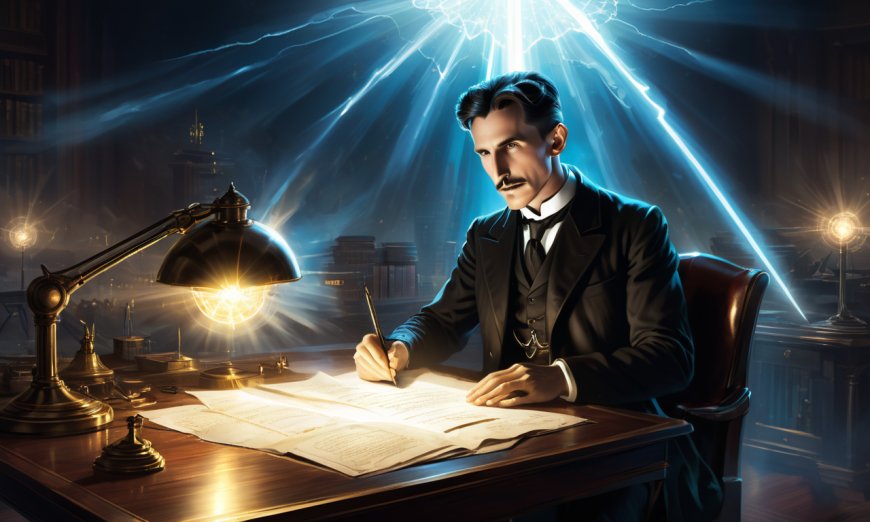


Nikola Tesla, one of the most brilliant inventors and visionaries in history, was known for his groundbreaking work in electricity and electromagnetism. Yet, alongside his many innovations, Tesla’s legacy is shrouded in mystery, controversy, and extraordinary claims. One of the most debated inventions linked to Tesla is the so-called "death ray," a powerful weapon he claimed could bring an end to all wars by making armed conflict impossible. But was Tesla’s death ray a real technological breakthrough, or was it simply the fantastical imagination of an eccentric genius? In this article, we will explore the history behind Tesla’s death ray, the scientific claims he made, and whether there’s any truth to the weapon that could supposedly destroy entire armies in an instant.
The Origins of Tesla’s Death Ray
- Tesla’s Vision for Global Peace
By the 1930s, Nikola Tesla had become a larger-than-life figure. He was renowned for his work on alternating current (AC) electricity, radio waves, and wireless transmission of energy. However, Tesla was also known for making bold, sometimes outlandish predictions about future technologies. One of his most extraordinary claims was the development of a particle beam weapon that he believed would make traditional warfare obsolete.
Tesla envisioned this weapon as a means to enforce global peace, referring to it as a "peace beam." In an interview with The New York Times in 1934, Tesla described his invention as a directed-energy weapon capable of projecting concentrated beams of particles over vast distances, destroying military targets such as planes, ships, and tanks with pinpoint accuracy. He claimed it could vaporize enemy forces and create an impenetrable defense around countries that possessed the technology. Tesla believed that if every nation had access to this weapon, the threat of mutual destruction would prevent wars from ever occurring.
- Tesla’s Bold Claims
Tesla called his invention "Teleforce" and stated that it was based on his earlier work with electrical energy and high-frequency oscillators. He claimed the device could generate beams of subatomic particles that traveled at nearly the speed of light, delivering immense energy to distant targets. According to Tesla, the death ray could strike targets hundreds of miles away, destroying them with unparalleled precision and power.
However, Tesla never demonstrated a working version of his death ray, and many of his contemporaries were skeptical of his claims. At the time, the concept of a directed-energy weapon was far beyond the scope of available technology, leading some to dismiss Tesla’s invention as science fiction.
The Science Behind the Death Ray
- Particle Beam Technology
The core idea behind Tesla’s death ray is the concept of a particle beam weapon. A particle beam is a stream of charged particles, such as electrons or ions, that can be accelerated to high speeds and directed toward a target. In theory, particle beams could be used to deliver destructive energy over great distances, making them a potential weapon.
Today, particle accelerators exist and are used in various scientific applications, such as physics experiments and medical treatments like cancer therapy. However, building a practical weapon based on particle beam technology poses significant challenges. The energy required to accelerate particles to the necessary speeds and maintain a focused beam over long distances is immense, and controlling such a beam would be incredibly difficult.
While Tesla claimed to have developed a method to generate these particle beams using high-voltage electricity, the technical details of how this would work were never fully explained. Some of Tesla’s notes suggest that he envisioned using vacuum tubes and electrical fields to accelerate particles, but these ideas were never successfully tested.
- Directed-Energy Weapons
In recent decades, modern militaries have experimented with directed-energy weapons (DEWs), such as lasers and microwave weapons. These technologies, while still in development, offer the potential to destroy targets using concentrated energy beams. Lasers, for example, can be used to disable drones, missiles, or electronics by delivering intense heat to a small area.
Tesla’s death ray concept shares similarities with these modern DEWs, but there are key differences. Lasers and microwaves use electromagnetic radiation, while Tesla’s death ray supposedly used streams of particles. Additionally, while modern DEWs are still limited in range and power, Tesla claimed that his death ray could strike targets hundreds of miles away—an extraordinary claim that has yet to be realized by today’s technology.
Was Tesla’s Death Ray Possible?
- Skepticism and Doubts
Despite Tesla’s confidence in his invention, most scientists and engineers at the time were skeptical of the feasibility of his death ray. Tesla was known for making ambitious claims that often stretched the boundaries of current technology, and without a working prototype, many dismissed the death ray as an unproven concept.
Moreover, the physics behind Tesla’s particle beam technology remains unclear. While particle beams can be generated in controlled environments, such as laboratories, projecting them over long distances and through the atmosphere is a significant challenge. The particles would likely disperse or be absorbed by air molecules, reducing the beam’s effectiveness.
- Did Tesla Build a Prototype?
Tesla claimed that he had constructed a small-scale version of the death ray in his laboratory, but he never publicly demonstrated it. In fact, Tesla was highly secretive about the details of the invention, likely due to his fears that the technology could be weaponized by hostile nations. During the 1930s, Tesla attempted to secure funding from governments around the world, including the United States, Britain, and the Soviet Union, but none of these nations chose to pursue the project.
After Tesla’s death in 1943, the FBI and U.S. government seized many of his papers and notes, hoping to uncover details about his inventions. However, no evidence of a functional death ray was ever found. Some conspiracy theories suggest that the government may have hidden Tesla’s work on the weapon, but there is no credible proof to support this claim.
The Legacy of Tesla’s Death Ray
- Tesla’s Influence on Modern Science Fiction
While Tesla’s death ray may never have become a reality, it has had a lasting impact on popular culture. The idea of a directed-energy weapon capable of destroying entire armies has been featured in countless science fiction stories, from ray guns in comic books to superweapons in movies like Star Wars. Tesla’s visionary imagination inspired generations of futurists, writers, and inventors to dream about the technological possibilities of tomorrow.
- Tesla’s Real Contributions to Technology
Despite the controversy surrounding the death ray, Tesla’s real contributions to science and technology cannot be overstated. His work on alternating current (AC) electricity, wireless energy transmission, and radio waves revolutionized the modern world and laid the foundation for much of today’s electrical infrastructure. Tesla’s innovations in power generation and distribution continue to shape how we produce and use electricity.
While the death ray remains a speculative footnote in Tesla’s career, his genuine achievements as an inventor and pioneer have cemented his place in history as one of the greatest minds of the 20th century.
A Little Fun Fact
Oh, and by the way, did you know that Tesla’s ideas for a death ray were so intriguing that after his death, the FBI classified some of his papers, even though they found no evidence of a working weapon? The mystery surrounding his final years continues to fuel conspiracy theories to this day!
Conclusion
Nikola Tesla’s death ray remains one of the most intriguing and controversial inventions in history. While there is no concrete evidence that Tesla ever built a functional particle beam weapon, his bold claims captured the imagination of the public and helped shape the futuristic visions of directed-energy weapons we see today. Whether the death ray was fact or fiction, it serves as a reminder of Tesla’s extraordinary creativity and his ability to envision technological advancements far ahead of his time.
And if you love unraveling mysteries and exploring the inventions of visionaries like Tesla, don’t forget to check out our word puzzle game, Sly Puzzle Games. It’s a fun way to challenge your mind and learn about the fascinating world of science and technology!