

The Multiverse Theory: Are There Infinite Versions of You?
Explore the multiverse theory, which posits that our universe might be just one of countless others, each with different versions of reality.
 Sly Puzzle Games



What if every decision you’ve ever made—every "what if?" moment—exists somewhere in a parallel universe? What if there are infinite versions of you, each living out different possibilities in countless other worlds? This is the tantalizing idea behind the multiverse theory, a concept that suggests our universe is just one of many, possibly infinite, universes that exist side by side, each with its own version of reality. While the multiverse theory may sound like science fiction, it is rooted in modern physics and raises profound questions about the nature of existence, time, and space. In this article, we will explore the different versions of the multiverse theory, the scientific foundations behind it, and what it might mean if there are infinite versions of you out there.
What is the Multiverse Theory?
- The Basic Concept
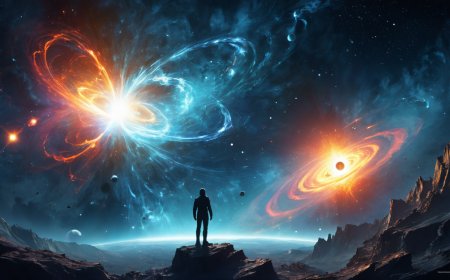
The multiverse theory proposes that our universe, with its vast galaxies, stars, and planets, is not the only one. Instead, it is just one "bubble" in a much larger "multiverse," where countless other universes exist. Each of these universes could have different physical laws, constants, and even different versions of events that play out across time and space. Some of these universes might be almost identical to our own, while others could be radically different, with variations in everything from the laws of physics to the outcomes of historical events.
- The Origins of the Multiverse Theory
The idea of the multiverse has been around for centuries in various forms of philosophy and mythology, but it gained scientific traction in the 20th century with the development of quantum mechanics and cosmology. One of the key contributors to the multiverse theory is physicist Hugh Everett, who proposed the "many-worlds interpretation" of quantum mechanics in the 1950s. According to Everett’s interpretation, every quantum event that has multiple possible outcomes creates a new universe in which each possibility is realized. In this view, the universe is constantly "branching" into multiple realities, with all possible outcomes occurring somewhere.
Different Versions of the Multiverse
There are several different interpretations of the multiverse theory, each with its own scientific basis. While they all suggest the existence of multiple universes, the specifics of how these universes are formed and how they interact vary.
- The Many-Worlds Interpretation (Quantum Multiverse)
The many-worlds interpretation (MWI) of quantum mechanics is perhaps the most famous version of the multiverse theory. In the quantum world, particles can exist in multiple states at once—a phenomenon known as superposition. When a quantum event occurs, such as a particle being measured, it "collapses" into one of its possible states. However, according to MWI, all possible outcomes of a quantum event occur, but each in a separate, parallel universe. This means that every time a decision is made, the universe splits into multiple branches, each representing a different outcome.
For example, if you flip a coin, the outcome is either heads or tails. In the many-worlds interpretation, both outcomes occur, but in different universes—one where you see heads and one where you see tails. This leads to the idea that there could be countless versions of you, each living in a universe where different decisions or events have played out.
- Bubble Universes (Inflationary Multiverse)
Another version of the multiverse theory comes from cosmology and the study of the early universe. The inflationary multiverse theory, based on the concept of cosmic inflation, suggests that after the Big Bang, the universe underwent a rapid expansion, creating "pockets" or "bubbles" of space-time. Each of these bubbles could be a separate universe, with its own unique physical laws and constants.
Our observable universe is just one of these bubbles, and there could be countless others floating in the multiverse. Some of these bubble universes might be similar to ours, while others could be radically different, with different dimensions, particles, or forces of nature.
- Brane Multiverse (String Theory)
String theory, which seeks to unify the fundamental forces of nature, introduces yet another version of the multiverse. According to string theory, the universe is made up of tiny, vibrating strings of energy, and our universe exists on a "brane," a three-dimensional surface embedded in a higher-dimensional space. There could be many other branes floating in this higher-dimensional space, each representing a different universe.
These brane universes might occasionally collide or interact with each other, producing observable effects in our universe, such as gravitational waves or other cosmic phenomena. The brane multiverse suggests that there could be entire universes existing just beyond our perception, separated by higher-dimensional space.
- Mathematical Universes
Another intriguing version of the multiverse comes from the idea that mathematics itself can describe all possible realities. According to the mathematical universe hypothesis, every mathematically consistent structure corresponds to a real, physical universe. In this view, any universe that can be described mathematically exists somewhere in the multiverse.
This interpretation suggests that there could be universes governed by entirely different mathematical rules, resulting in realities that are incomprehensible or vastly different from our own. While this idea is more abstract, it highlights the idea that the multiverse could encompass an infinite variety of possibilities.
The Implications of the Multiverse Theory
- Are There Infinite Versions of You?
One of the most intriguing implications of the multiverse theory is the idea that there could be infinite versions of you living in parallel universes. If every possible outcome of every decision is realized in some universe, then there could be universes where you made different choices, leading to vastly different life paths. In one universe, you might have chosen a different career or married someone else. In another, you might not exist at all.
This raises profound questions about identity, free will, and the nature of reality. Are these other versions of you truly "you," or are they completely separate individuals living out their own realities? And if the multiverse exists, does that mean that every possible version of your life is happening somewhere?
- The Nature of Reality
The multiverse theory challenges our traditional understanding of reality. If multiple universes exist, what does that mean for the concept of a single, objective reality? Are there many realities, each as valid as our own, or is there a "base" reality from which all others branch off? The multiverse theory suggests that reality might be much more complex and multidimensional than we ever imagined.
- Testing the Multiverse
While the multiverse theory is fascinating, it remains largely speculative. One of the biggest challenges is finding a way to test or prove the existence of other universes. Because parallel universes would exist outside our observable universe, they would be difficult—if not impossible—to detect directly. However, some scientists are looking for indirect evidence, such as patterns in cosmic radiation or gravitational waves that might hint at the presence of other universes.
A Little Fun Fact
Oh, and by the way, did you know that in some interpretations of the multiverse theory, there could be a universe where dinosaurs never went extinct, or one where Earth never formed at all? The possibilities are truly endless, and every conceivable reality might exist somewhere in the multiverse.
Conclusion
The multiverse theory is one of the most mind-boggling and exciting ideas in modern science, suggesting that our universe is just one of countless others, each with its own version of reality. While the theory remains speculative, it raises profound questions about existence, free will, and the nature of reality itself. If the multiverse does exist, there could be infinite versions of you, living out every possible version of your life in parallel worlds. As scientists continue to explore the mysteries of the universe, we may one day find evidence of these alternate realities—or perhaps even discover ways to interact with them.
And if you love solving cosmic mysteries and exploring the wonders of the universe, don’t forget to check out our word puzzle game, Sly Puzzle Games. It’s a fun way to keep your mind sharp while contemplating the infinite possibilities of the multiverse!