

The Book of Eli: Symbolism and Secret Messages in the Apocalypse
The Book of Eli, directed by the Hughes Brothers, presents a post-apocalyptic world filled with desolation, violence, and survival. At its center is Eli, a lone wanderer carrying a mysterious book that he believes will restore humanity. This book, as revealed in the film, is the last known copy of the Bible, which Eli protects with his life. As he journeys through this bleak world, Eli’s actions, encounters, and faith are laden with symbolism and hidden messages that elevate The Book of Eli beyond a standard action movie, transforming it into a profound exploration of faith, redemption, and humanity’s struggle to find hope in darkness.
 Sly Puzzle Games


Let’s unpack the symbolism and hidden messages within The Book of Eli to uncover the deeper meanings behind this apocalyptic story.
1. The Bible as a Symbol of Knowledge and Power
At the heart of The Book of Eli is the Bible, a powerful symbol of knowledge, morality, and spiritual guidance. In the devastated world of the film, books are scarce, and the Bible is seen as both a threat and a treasure. Eli sees it as a source of wisdom and redemption, while Carnegie, the film’s antagonist, wants to use it as a tool to manipulate and control others.
This conflict over the Bible reflects the power of knowledge and its potential for both good and evil. Eli’s mission to preserve the Bible suggests the importance of faith, resilience, and preserving culture even in times of despair. The film uses the Bible as a symbol of hope and moral strength, a reminder that spiritual knowledge can help guide humanity through even the darkest times.
2. Eli’s Blindness as a Metaphor for Faith
One of the film’s most significant reveals is that Eli is blind, relying on his faith to guide him through his journey. Despite his blindness, Eli’s sense of purpose is unwavering, suggesting that his “sight” is derived from an inner vision and spiritual conviction. This blindness is a powerful metaphor for faith — the belief in something beyond what can be seen or proven.
Eli’s blindness reflects the idea that true faith transcends physical limitations and that belief can empower individuals to accomplish extraordinary feats. By portraying Eli as both physically vulnerable and spiritually strong, the film suggests that faith is not about sight or certainty but about trust and resilience. Eli’s journey encourages viewers to look beyond the tangible and recognize the strength that comes from inner conviction.
3. The Apocalyptic Setting: A World in Moral and Spiritual Decay
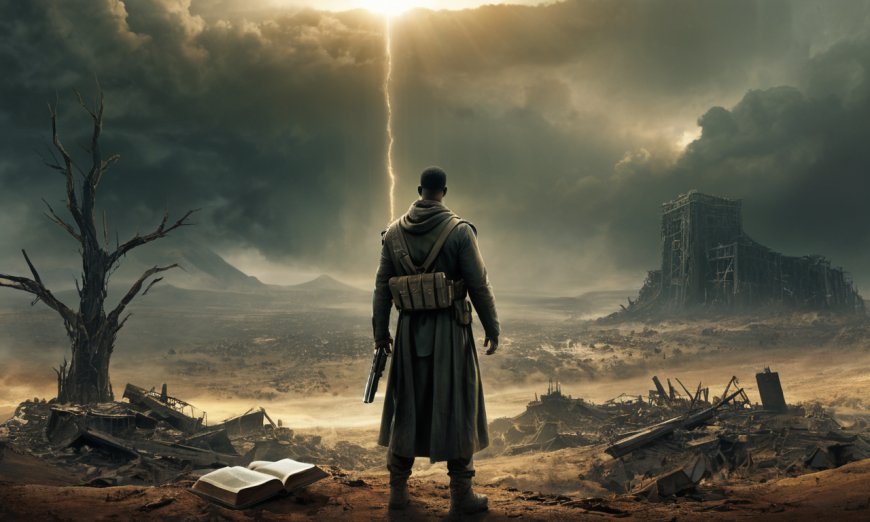
The post-apocalyptic landscape in The Book of Eli is barren, violent, and devoid of compassion, reflecting the moral and spiritual decay that has taken hold of humanity. This bleak world is a metaphor for a society that has lost its ethical compass, where survival has replaced empathy and power is often gained through fear and manipulation. In this setting, Eli’s mission to protect the Bible becomes a quest to restore not just faith but also morality and purpose.
The apocalyptic setting underscores the film’s message that without a moral foundation, society becomes a harsh, brutal place. Eli’s journey symbolizes a struggle to bring light and guidance to a world shrouded in darkness. The film suggests that spiritual and moral values are essential for a thriving society, and without them, humanity risks falling into a state of chaos and despair.
4. Carnegie’s Quest for Control: The Corruption of Religion
Carnegie, who leads a small town with an iron fist, seeks to control people by obtaining the Bible, not for its wisdom but for its power to manipulate. He sees religion as a means to exert influence, believing that he can use the Bible’s teachings to gain more control over the desperate population. Carnegie’s ambition reflects the corruption that can arise when religion is used for personal gain rather than spiritual guidance.
Through Carnegie, The Book of Eli critiques the misuse of religion as a tool for control. It warns against leaders who seek to exploit faith for selfish reasons, rather than encouraging true understanding and compassion. Carnegie’s character serves as a cautionary symbol, reminding viewers that spirituality should not be used to justify oppression, but rather to inspire empathy and unity.
5. The Theme of Redemption and Sacrifice
Eli’s journey is marked by his willingness to sacrifice for the greater good. His unwavering commitment to protecting the Bible, despite the numerous dangers he faces, reflects his belief that humanity is still worth saving. This theme of sacrifice is echoed in the final scenes, where Eli, after completing his mission, dies peacefully, knowing he has fulfilled his purpose.
Eli’s sacrifice highlights the theme of redemption, suggesting that even in a broken world, there are individuals willing to give everything to preserve hope and knowledge. His selflessness becomes a powerful reminder of the strength of the human spirit and the importance of protecting the values that define humanity. Eli’s journey of sacrifice resonates as a testament to resilience, inspiring viewers to consider the impact of their own actions on the world around them.
6. The Ending: Knowledge as a Beacon of Hope
In the film’s conclusion, Eli finally reaches Alcatraz, where he transcribes the entire Bible from memory, ensuring that its teachings survive. This act symbolizes the resilience of knowledge and faith, suggesting that even in the face of destruction, wisdom can endure. The scene where the newly transcribed Bible is placed on a shelf alongside other religious texts represents hope for a future where knowledge and faith coexist.
The ending of The Book of Eli emphasizes the transformative power of knowledge and spirituality, offering a vision of hope despite the harshness of the apocalyptic world. By preserving the Bible, Eli contributes to rebuilding society on a foundation of ethics and compassion. The film’s ending suggests that while material things can be lost, the human spirit and the drive to preserve culture and wisdom can never be extinguished.
Interesting Fact
Did you know that Denzel Washington performed many of his own stunts and fight scenes in The Book of Eli? Washington trained intensively for the role, mastering a unique form of martial arts to create Eli’s precise and methodical fighting style, further adding to his character’s sense of purpose and discipline.
Conclusion
The Book of Eli is a film rich with symbolism and themes that explore faith, morality, and resilience in the face of despair. Through Eli’s journey, the Bible’s preservation, and the moral decay of a post-apocalyptic world, the film becomes a parable about the importance of spiritual values and knowledge. Its portrayal of faith as a guiding force, even in a world devoid of hope, challenges viewers to consider the role of spirituality and morality in their own lives.
By combining action with profound messages, The Book of Eli offers a story of redemption, sacrifice, and the enduring power of faith. Its exploration of how religion and knowledge can both uplift and corrupt reminds audiences of the importance of using faith to inspire rather than control. The film ultimately suggests that even in the darkest of times, humanity can find light through belief, knowledge, and selflessness, making The Book of Eli a powerful reflection on hope and resilience.