

The Moving Stones of Death Valley: Nature's Oddity
Examine the phenomenon of the "sailing stones" in Death Valley, California. Discuss scientific studies that attempt to explain how these rocks move across the desert floor.
 Sly Puzzle Games
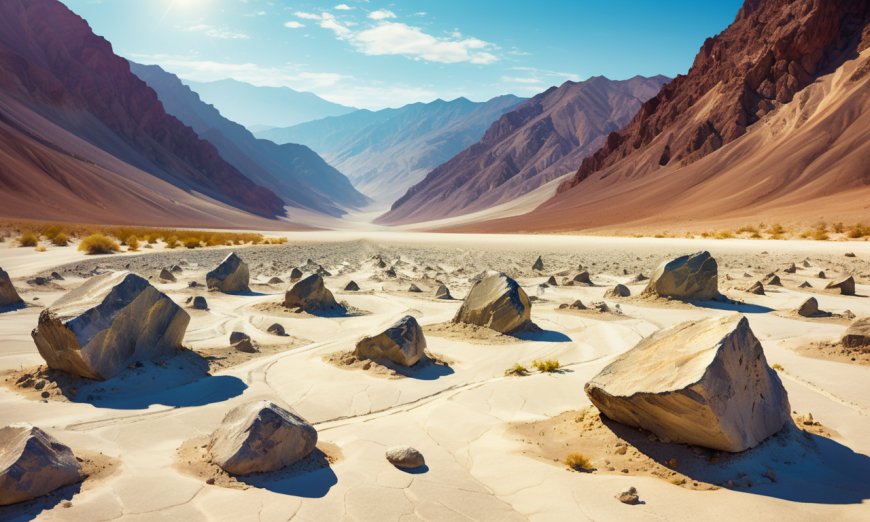


In the arid and desolate landscape of Death Valley, California, a perplexing and fascinating natural phenomenon occurs: rocks, some weighing hundreds of pounds, seemingly move across the desert floor, leaving long trails behind them. This mysterious event, known as the "sailing stones" or "sliding rocks," has intrigued scientists and visitors for decades. Let’s explore the history of this phenomenon, the scientific studies conducted, and the explanations proposed to unravel this desert enigma.
The Racetrack Playa
- Location and Description
The moving stones are found on the Racetrack Playa, a dry lakebed located in a remote part of Death Valley National Park. The playa is a flat, mud-cracked surface surrounded by mountains, creating a dramatic and isolated setting for this unusual phenomenon.
- First Observations
Reports of the moving stones date back to the early 20th century. In the 1940s, geologists began documenting the trails left by the rocks, sparking curiosity and prompting scientific investigations.
The Phenomenon
- Rock Movement
The rocks on the Racetrack Playa move sporadically, leaving long, straight or curved trails behind them. These trails can stretch for hundreds of feet and vary in direction and length. The movement of the stones is sporadic, with rocks remaining stationary for years before suddenly shifting.
- Characteristics of the Stones
The rocks vary in size, with some weighing a few ounces and others up to several hundred pounds. They are primarily composed of dolomite and syenite, materials that have eroded from the surrounding mountains and fallen onto the playa.
Scientific Investigations
- Early Theories
Initial theories to explain the phenomenon included strong winds, magnetic forces, and even supernatural influences. However, these explanations were either debunked or deemed insufficient to account for the movement of such heavy rocks.
- The Wind and Ice Theory
In the 1950s, researchers proposed that a combination of wind and ice could be responsible for the rock movements. This theory suggested that during rare rain events, the playa would flood, and when temperatures dropped, a thin layer of ice would form. The ice, coupled with strong winds, could push the rocks across the slick surface. While this theory gained traction, it lacked direct observational evidence.
- Modern Research and GPS Tracking
In the early 2000s, a team of researchers from NASA and various universities conducted more detailed studies using time-lapse photography and GPS technology. In 2011, researchers from the Scripps Institution of Oceanography placed GPS devices on several rocks to monitor their movements. These studies confirmed that the rocks did indeed move but left the exact mechanism unclear.
- The 2013 Breakthrough
In December 2013, researchers Richard Norris and James Norris of the Scripps Institution of Oceanography finally captured the movement of the stones on video. They discovered that under specific conditions, a thin layer of water would form on the playa's surface during winter nights, freezing into sheets of ice. As the ice began to melt under the sun, it broke into large floating panels that were driven by light winds, gently pushing the rocks along the slick, wet mud.
The Confirmed Explanation
The Norris brothers' study provided the most compelling explanation: during rare conditions when there is just enough water to form ice, but not too much to submerge the rocks, the thin ice sheets float and are propelled by light breezes. This movement is slow, sometimes only a few inches per second, but over hours or days, it is enough to create the long trails observed on the playa.
A Little Fun Fact
Oh, and by the way, did you know that the Racetrack Playa is one of the driest places in North America, yet it is the occasional presence of water that enables the sailing stones to move? This paradox adds another layer of intrigue to this natural oddity.
Conclusion
The moving stones of Death Valley's Racetrack Playa represent a remarkable intersection of geology, meteorology, and physics. While the mystery of the sailing stones has been largely solved through modern scientific research, the phenomenon continues to captivate and draw visitors to this remote part of the world. The interplay of wind, ice, and water in one of the harshest environments on Earth reminds us of the subtle and intricate forces that shape our natural world.
And if you love solving mysteries and exploring natural phenomena, don’t forget to check out our word puzzle game, Sly Puzzle Games. It's a great way to keep your brain sharp and entertained. Happy exploring!