

Edge of Tomorrow: Do Time Loops Exist in Real Life?
Doug Liman’s Edge of Tomorrow, starring Tom Cruise and Emily Blunt, is a sci-fi action thriller with a fascinating twist: the protagonist, Major William Cage, is caught in a time loop. Each time he dies, he’s forced to relive the same day, giving him a chance to learn, adapt, and potentially alter the outcome of humanity’s battle against alien invaders. While the time loop concept is thrilling as a narrative device, it also raises an intriguing question: could time loops exist in real life?
 Sly Puzzle Games
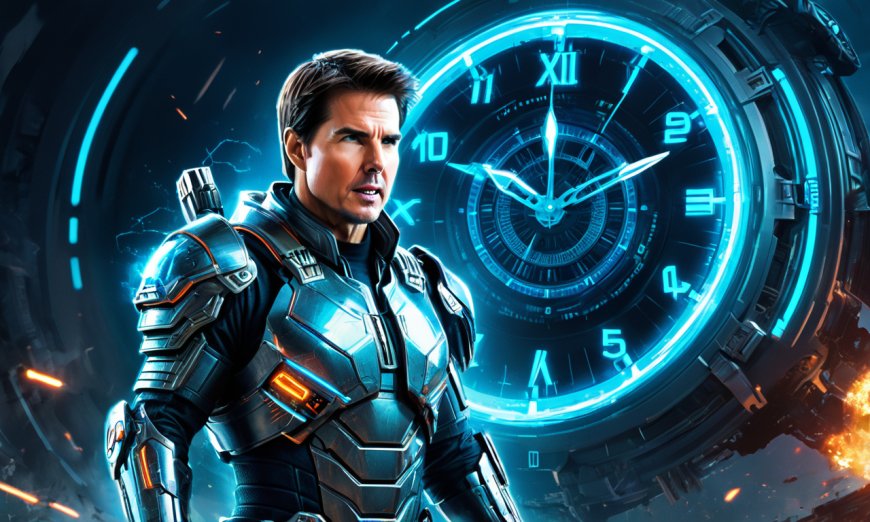


To explore this, we’ll delve into the science of time loops, their basis in theoretical physics, and whether Edge of Tomorrow’s concept has any grounding in reality.
1. What Is a Time Loop?
In science fiction, a time loop occurs when a person or event is caught in a repetitive cycle, replaying the same sequence of time endlessly or until certain conditions are met. Edge of Tomorrow explores this concept through Cage’s continuous reliving of a single day, which allows him to perfect his strategy and eventually become humanity’s best hope.
Time loops are a narrative tool that plays with the concept of determinism — the idea that every event is caused by preceding events. In Edge of Tomorrow, the loop is triggered by alien technology, suggesting a fictional explanation rooted in advanced science. But could something like this happen in reality?
2. Time Loops and Physics: Is It Possible?
In theoretical physics, time loops are often associated with closed timelike curves (CTCs), which were proposed by physicist Kurt Gödel in 1949. According to Gödel, under certain conditions in Einstein’s theory of general relativity, time could theoretically curve back on itself, creating a loop. This concept is tied to the fabric of spacetime and is sometimes linked to the presence of massive objects, such as black holes, which can warp spacetime.
While time loops are mathematically possible in general relativity, they face significant challenges in the real world. For instance:
- Causality Paradoxes: Time loops could create paradoxes, such as the famous “grandfather paradox,” where changing past events could disrupt the present or future.
- Quantum Mechanics: On a quantum level, time is not as linear as it appears in our daily lives, but there’s no evidence to suggest time loops occur in nature.
While theoretical, these ideas keep time loops within the realm of possibility — at least in extreme and highly speculative scenarios.
3. Deja Vu: A Real-Life “Time Loop” Feeling?
While actual time loops may not exist, the phenomenon of deja vu — the sensation that you’ve already experienced a moment before — shares a thematic similarity. Deja vu occurs when the brain processes a current event as if it were a memory, creating a fleeting sense of reliving the moment.
Some scientists believe deja vu might be linked to how the brain stores and retrieves information, while others suggest it could be tied to small glitches in how memories are formed. Though not a literal time loop, deja vu offers a psychological explanation for the eerie feeling of repetition in life.
4. Time Perception and the Brain: A Loop in Perspective
Our perception of time is largely controlled by our brain’s processing of events. Under certain conditions, such as intense stress or altered states of consciousness, time can feel distorted. Some individuals have reported experiencing “time dilation” — where moments seem to stretch or repeat — during near-death experiences or under the influence of certain substances.
This altered perception of time may be the closest we come to experiencing a “time loop.” While it’s not the same as reliving the same day repeatedly, it suggests that time, as we experience it, is not as fixed as it appears.
5. Alien Technology and Time Manipulation: Fiction or Foreshadowing?
In Edge of Tomorrow, the time loop is triggered by alien biology, specifically through contact with an Alpha and Omega — advanced beings capable of resetting time. While this is purely fictional, it raises the question of whether advanced civilizations could manipulate time in ways beyond our understanding.
Theoretical physicist Michio Kaku has speculated that sufficiently advanced technologies could theoretically exploit the laws of physics to manipulate time. For example:
- Wormholes: Hypothetical passages through spacetime could allow shortcuts between points, potentially enabling time travel or loops.
- Quantum Entanglement: While primarily a phenomenon of particles, some have speculated about its implications for time and causality.
While alien time-resetting biology is pure science fiction, it taps into the fascinating possibility that our understanding of time is incomplete and may one day be challenged by discoveries beyond Earth.
6. Philosophical Implications: Living the Same Day to Improve Ourselves
Beyond the science, Edge of Tomorrow uses the time loop as a metaphor for self-improvement and growth. Cage’s repeated failures force him to confront his fears, learn new skills, and evolve into a better version of himself. This idea reflects the human experience of learning through repetition and persistence.
The film suggests a philosophical takeaway: while we may not live in literal time loops, life often gives us multiple chances to improve and overcome challenges. Each day can be seen as an opportunity to refine our actions, much like Cage’s journey in the movie.
Interesting Fact
Did you know that the original Japanese novel All You Need Is Kill, on which Edge of Tomorrow is based, features an even darker and grittier depiction of time loops? While the film explores themes of growth and sacrifice, the novel delves deeper into existential despair and the psychological toll of reliving the same day.
Conclusion
While time loops like those in Edge of Tomorrow remain firmly in the realm of science fiction, the film’s concept touches on real-world theories about time and the human experience of repetition. From the mathematical possibility of closed timelike curves to the psychological phenomena of deja vu, the idea of reliving moments isn’t entirely alien to our understanding of reality.
More than just a sci-fi thriller, Edge of Tomorrow uses the time loop as a lens to explore resilience, self-improvement, and the potential for growth through failure. Whether or not time loops exist in real life, the lessons from the film encourage us to treat every day as a chance to improve, adapt, and push forward.